REVIEW · ART GALLERIES & MUSEUMS
London: Guided Tour of the Natural History Museum
Book on GetYourGuide →Operated by Golden Tours - Gray Line London · Bookable on GetYourGuide
Step into a world where time is on display. This Natural History Museum tour gives you a fast, guided path through the big, must-see collections without turning your visit into a scavenger hunt. I especially like how it frames evolution as a story you can actually follow, not just a list of exhibits.
Two highlights for me: the blue whale skeleton in the Marine Life section and the clear way the museum connects humans to the rest of life in the Human Evolution Gallery. You don’t need to be a science person to get what’s happening here.
One drawback to consider: the guided service has had reliability complaints in past bookings, including cases where the guide didn’t show up or the tour ran short. So I’d treat this as a great museum visit with a guide attached, not something to bet your whole day on.
In This Review
- Key things to know before you go
- Finding Golden Tours at the Natural History Museum
- Bag check to grand hall: what the museum does before you even sit still
- Dinosaur Gallery and Mammals: scale, skeletons, and why names matter
- Marine Life and the blue whale skeleton you won’t forget
- Human Evolution Gallery: fossils, life-sized models, and the big picture
- Volcanoes, Earthquakes, and Earth Sciences: rocks that explain how the planet moves
- Wildlife Garden: a quick reset outside the main exhibits
- Ending at the café and gift shop: don’t rush your exit
- Price and value: is $40 worth it for a 2-hour guided sweep?
- Who should book this tour (and who might skip it)
- Should you book this guided Natural History Museum tour?
- FAQ
- How long is the London Natural History Museum guided tour?
- What’s included in the price?
- How much does the tour cost?
- Where do I meet the Golden Tours guide?
- What time should I arrive?
- Is the tour wheelchair accessible?
- Is this an official Natural History Museum tour?
Key things to know before you go
- Meeting point clarity: Find the long-necked bronze dinosaur statue in Evolution Garden and look for the blue and white Golden Tours umbrella.
- Architecture plus specimens: Expect terracotta arches, columns, and playful wall monkeys linked to the Darwin vs. Owen story.
- Big-name galleries in 2 hours: Dinosaur, mammals, marine life, human evolution, and earth sciences all get covered.
- Geology isn’t boring here: Volcanoes and Earthquakes-style themes show up alongside gemstones and volcanic rocks.
- A break in the middle: The Wildlife Garden gives you air and movement outside the main halls.
- End-of-tour comfort: It finishes at the café and gift shop, so you can reset without scrambling across the museum.
Finding Golden Tours at the Natural History Museum
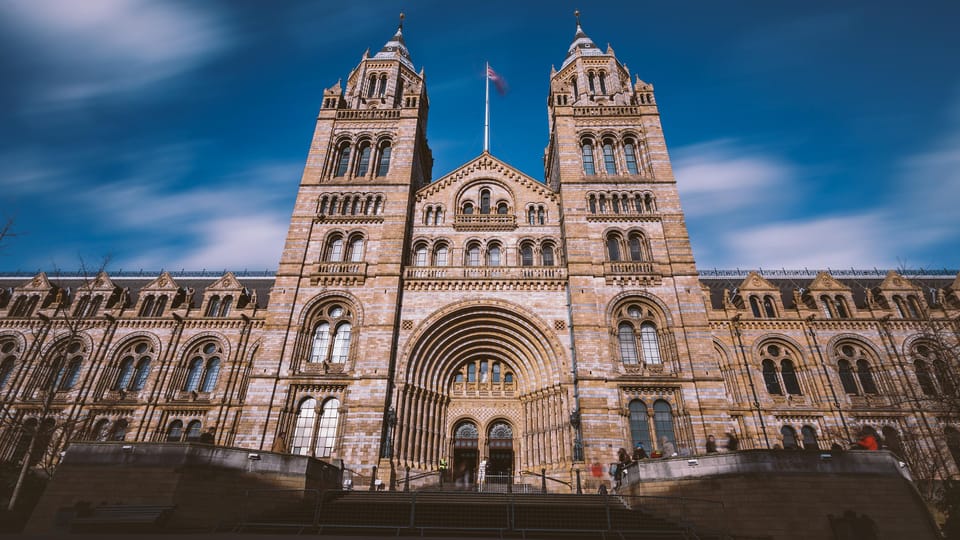
This starts in a very specific place, which is a good thing. Go to the Natural History Museum main entrance on Cromwell Road in South Kensington (SW7 5BD) and follow signs for the main entrance. Then you’ll use the museum grounds to line up your exact meeting spot.
For your Golden Tours guide, use this visual: in the Evolution Garden, look for the large bronze skeleton statue of a long-necked dinosaur. Your guide should be located opposite it, holding a blue and white Golden Tours umbrella. Plan to arrive at least 15 minutes early so you’re not racing other groups or standing around wondering.
The tour is described as wheelchair accessible, but the museum is also busy and spread out. If you’re using mobility support, I’d still come early so you can get your bearings before the group starts moving.
You can also read our reviews of more guided tours in London



Bag check to grand hall: what the museum does before you even sit still
Your experience begins right at the front: you pass through Bag Check and then the Contactless Donations queue. It sets the rhythm fast, because once you’re inside, you’re in a building that feels built to impress.
Just before you hit the main galleries, you’ll see a tall giraffe skeleton standing alongside a taxidermy giraffe. It’s a simple pairing, but it tells you what this museum likes to do: connect the idea of a specimen with the scale of the animal, so you feel the difference between a model and something that once lived.
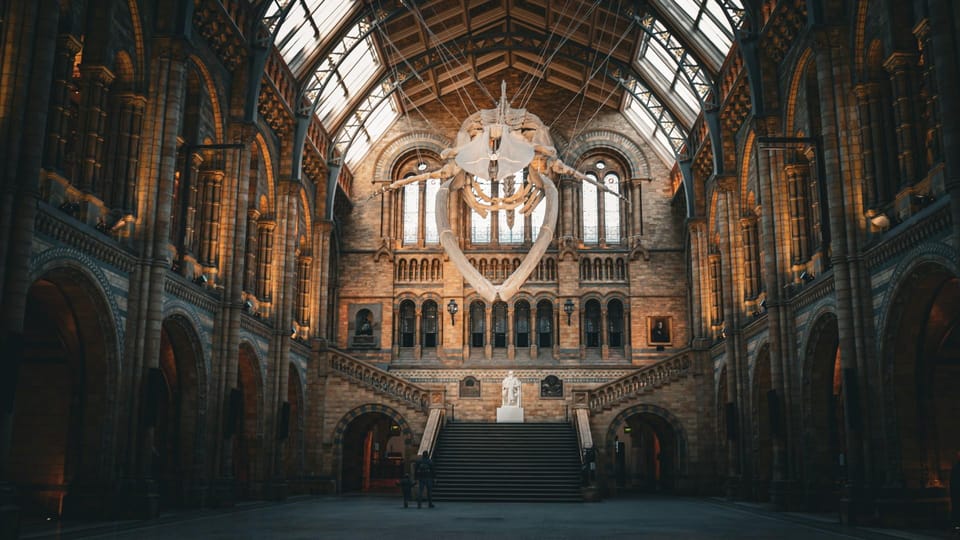
Then comes the grand hall. The terracotta arches and columns create that classic “cathedral of science” feeling. And yes, there are terracotta monkeys scaling the walls—a nod to Sir Richard Owen’s rivalry with Charles Darwin. Even if you don’t know that history yet, the museum quietly teaches you how debates shaped what was collected, displayed, and understood.
This matters because the tour isn’t only about facts. It’s about context—how people argued, studied, and built collections, and how those collections became a public way to think about the natural world.
Dinosaur Gallery and Mammals: scale, skeletons, and why names matter
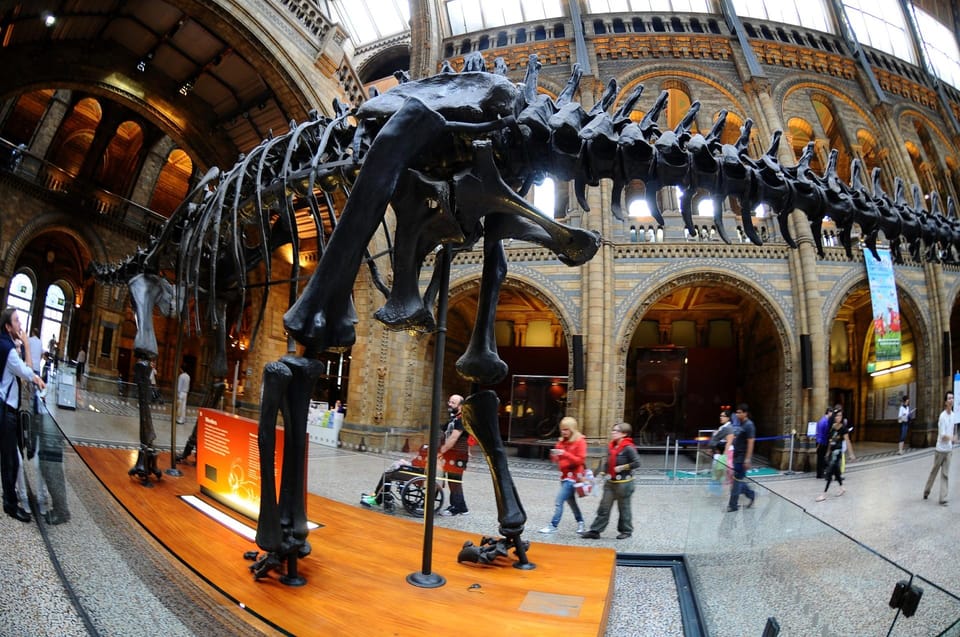
The first major stop is the Dinosaur Gallery. Expect to see prehistoric skeletons, including the famous Diplodocus. When you’re walking through a gallery like this with a guide, the value isn’t that you’re staring at bones. It’s that you’re being pointed toward what to notice: the size cues, the structural details, and the “how do we know” thinking behind reconstructing ancient animals from remains.
After dinosaurs, the tour shifts to the Mammals Gallery, where the tone changes from ancient time to living diversity. You’ll see taxidermy specimens and skeletons, including examples like African elephants and cheetahs. This section works well during a short guided visit because it anchors evolution in recognizable animals. You can look at features and connect them back to adaptation—how body shape and movement fit the environment.
One practical thought: mammal displays can feel busy, especially in a popular museum. In a group tour, you’ll usually get enough guidance to make your own quick comparisons without getting stuck in front of every single case for too long.
Marine Life and the blue whale skeleton you won’t forget
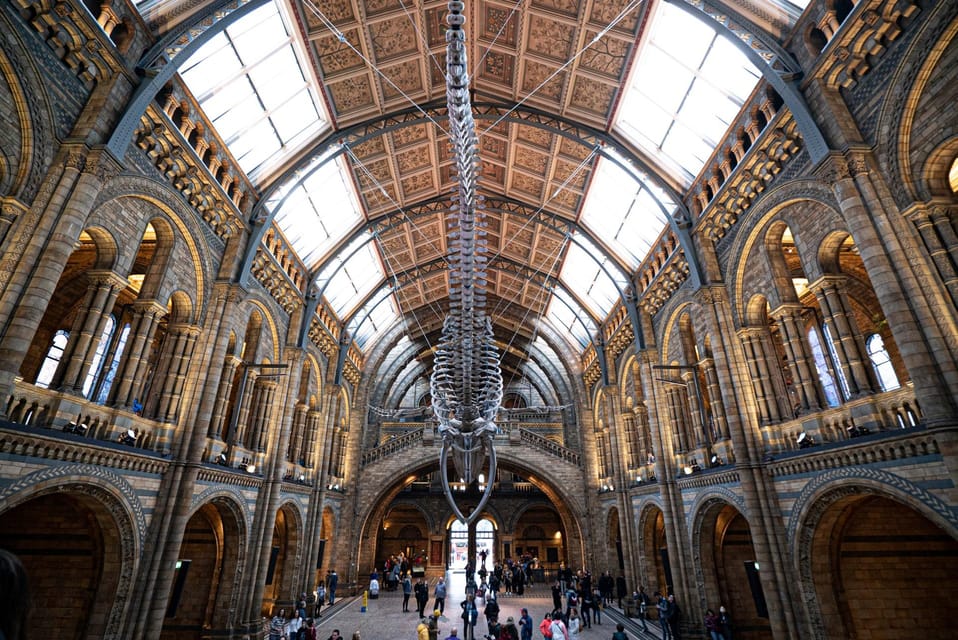
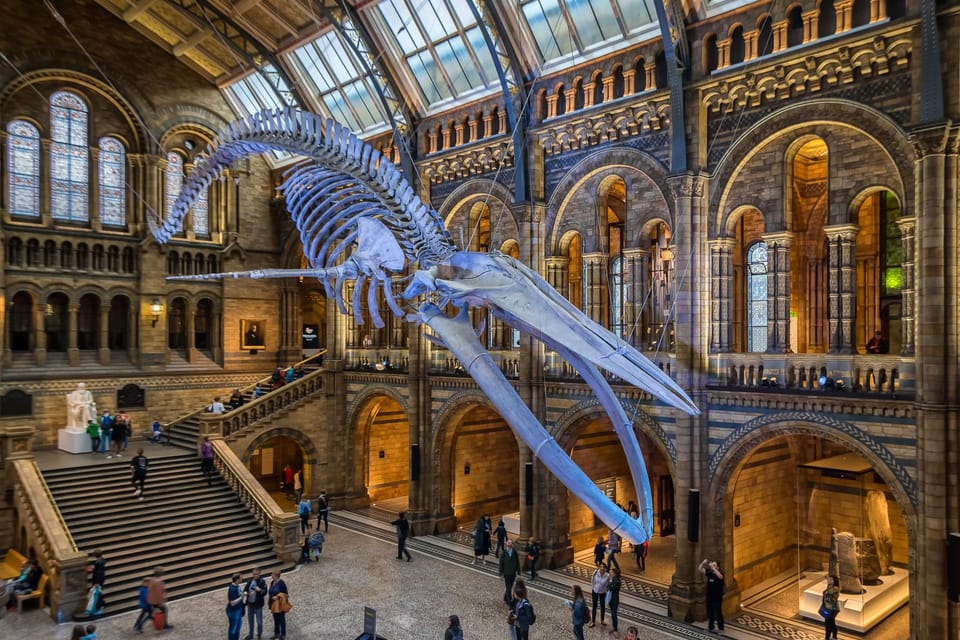
If you want a single image to keep from this visit, make it the Marine Life section. The centerpiece here is the blue whale skeleton suspended from the ceiling. It’s the kind of exhibit that changes your sense of scale immediately, even before the science details land.
With a guide, you can focus on the right things without needing to read every label. I like how this section turns “ocean biodiversity” into something visual and physical. You’re not just learning that whales are animals; you’re seeing the sheer size of one and letting your brain reframe what you think “big” means in nature.
This stop is also where your tour’s pacing starts to feel real. A guided route helps, because you’re moving from room to room with purpose. But it can also mean you’ll see marine life at a speed faster than you might on your own. If you’re the type who wants extra time for photos and label-reading, you’ll likely want to plan a little solo time at the end—especially if the rest of your day is flexible.
Human Evolution Gallery: fossils, life-sized models, and the big picture
Next up is the Human Evolution Gallery. This is where the museum shifts again: from animals as categories to humans as part of the same biological process.
You’ll see life-sized models and fossilized remains. That combination helps more than you might expect. Models can show anatomy in a way fossils alone can’t, while fossils keep the story grounded in evidence. Together, they help you understand evolution as a chain with gaps and clues—not as a neat, straight line.
In a tour that’s only 2 hours, this gallery is an efficient stop. It gives you enough orientation to leave with a sense of the narrative. You don’t have to be an expert to “get” the idea that humans are studied in the same scientific spirit as other life—through bones, comparisons, and interpretation.
My advice: when you get here, don’t try to read every label top to bottom. Instead, pick one or two spots your guide points out and let the rest support those anchors.
You can also read our reviews of more historical tours in London






Volcanoes, Earthquakes, and Earth Sciences: rocks that explain how the planet moves
The tour concludes with the Earth Sciences side, which includes a focus on geology themes like Volcanoes and Earthquakes, plus an assortment of stones and materials such as gemstones and volcanic rocks.
This part of the museum can feel different from the biology galleries because it’s less about creatures and more about processes. You’re looking at evidence that the planet is active—shaped by heat, pressure, and movement. In a guided setting, that’s useful, because a guide can point out how to read the exhibits: what’s sample vs. what’s interpretation, and what the rocks are telling you about past conditions.
Also, if you tend to think of museums as “stuff behind glass,” geology is a good correction. Rocks are physical history. They look still, but the ideas behind them are dynamic.
Wildlife Garden: a quick reset outside the main exhibits
Between indoor galleries, there’s a stop for the Wildlife Garden, described as a haven for birds, bees, and other animals. Even if you don’t catch every creature on camera, the point is the change of pace.
This garden helps your visit feel less like a sprint through rooms and more like a full museum experience. You’ll get a bit of movement, air, and a different kind of learning—one where nature isn’t only a display. It’s also a nice time to regroup if your legs are feeling it.
Because the tour is time-limited, I’d treat this as a “touch grass and get your energy back” moment, not a long nature walk. If you want more time with the garden, plan to return later after the guided portion ends.
Ending at the café and gift shop: don’t rush your exit
The tour wraps up at the museum’s café and gift shop. That’s a practical landing spot. You don’t have to figure out where you are in relation to everything else or scramble for a place to sit.
You can relax, grab a drink or snack if you planned for it separately, and then browse the shop if you want a souvenir tied to your favorite gallery. Even if you skip the café, the gift shop is a convenient place to slow down and decide if you want to add extra time in the museum on your own.
When you leave, look back at the architecture. The tour notes the museum’s wall carvings and the broader legacy of both extinct and living species. It’s a fitting end: you see that the collections aren’t only scientific—they’re also a public statement about time, change, and continuity.
Price and value: is $40 worth it for a 2-hour guided sweep?
At about $40 per person for a 2-hour guided tour, the value depends on how you like to travel.
If you’re the kind of person who enjoys orientation—someone pointing out the right exhibits in the right order—then this price can feel fair. The museum is huge, and the tour is designed to compress several top galleries into one visit: dinosaur life, mammals, marine life, human evolution, and earth sciences themes.
What you don’t get matters too. Transportation and food and drink aren’t included, so you’ll still budget for getting there and for anything you want to eat. But the good news is that the tour ends at the café area, so you’re not stuck far from a place to recharge.
One thing to consider: the guided element doesn’t replace the museum. It speeds you up. If you’re a slow museum walker who wants full label reading, you may feel like two hours is too short. In that case, treat the guide as a way to pick favorites, then plan a follow-up visit window on your own.
Who should book this tour (and who might skip it)
This tour is a good match if you want structure. If you’re visiting the Natural History Museum for the first time and you’d like to see the big, iconic sections—dinosaur, whale skeleton, human evolution, geology—without building your own route, you’ll appreciate the guidance.
It’s also a decent fit if you enjoy “how to look” help: what to focus on in a room, how to connect exhibits, and how to keep your time moving. The museum is full of details, and a short guided route helps prevent you from getting stuck in only one gallery for the whole day.
If you dislike group pacing, you might want to skip the tour and plan self-guided. You’ll lose some context, but you gain control over where you linger.
And one more practical caution: there have been serious service issues reported for some past bookings, including cases where the guide didn’t arrive or the group didn’t get the full planned experience. If your trip is tight or you have a museum-only day, I’d still consider having a plan B: you should be able to enter the museum and enjoy at least a few core galleries on your own even if the group portion doesn’t work out.
Should you book this guided Natural History Museum tour?
I’d book this if you want a fast, guided highlight circuit through some of the museum’s most famous themes—especially that blue whale moment and the Human Evolution section. It’s an efficient way to see the museum’s main arguments: life changes over time, humans fit into that story, and the planet itself is always active.
But I wouldn’t treat it as your only plan or your single point of success. Because there are reports of guides not showing up or tours running short, you’ll feel better if you arrive early, stay alert to the meeting instructions, and keep enough flexibility in your day to enjoy the museum even without perfect guidance.
If you’re okay with a short guided visit plus some extra self-guided time after, this can be a strong use of a couple hours in London.
FAQ
How long is the London Natural History Museum guided tour?
The tour lasts 2 hours.
What’s included in the price?
The included part is a guided tour. Transportation and food and drink are not included.
How much does the tour cost?
It’s listed at $40 per person.
Where do I meet the Golden Tours guide?
Meet at the Natural History Museum main entrance area. In Evolution Garden, find the large bronze skeleton statue of a long-necked dinosaur, and look for your Golden Tours guide opposite it holding a blue and white umbrella.
What time should I arrive?
Arrive at least 15 minutes before the tour time.
Is the tour wheelchair accessible?
Yes, it’s described as wheelchair accessible.
Is this an official Natural History Museum tour?
No. It is organized and operated by Golden Tours and is not the official tour provided by the Natural History Museum.