REVIEW · WORKSHOPS
Woolf & Dickens: London Literary Tour & Writing Workshop
Book on GetYourGuide →Operated by JPierson · Bookable on GetYourGuide
Waterloo Bridge sparks your pen. This 1.5-hour workshop turns real London corners into writing prompts, with Virginia Woolf at the center and Waterloo Bridge as your opening view. You’ll get short readings from major English writers, then you’ll respond on the page instead of just listening.
I especially like two parts: the mindful writing experiment at Somerset House, and the way Joseph creates a kind, safe learning vibe for all levels. You don’t need to be a published author to participate, and you can bring your own style without being pushed into someone else’s.
One possible drawback: with only 1.5 hours, you’ll finish feeling stimulated, not fully satisfied. If you want long practice sessions, treat this as a focused taste of creative writing in the field.
In This Review
- Key points worth knowing before you go
- From Waterloo Bridge to a page you can fill
- Virginia Woolf’s view from Waterloo Bridge: where mood becomes a sketch
- Somerset House: the mindful experiment that changes your pace
- Aldwych and T.S. Eliot: time on the walls, then on your page
- St Mary Le Strand: ekphrasis in a real room
- Gladstone’s statue and the politics of truth
- Doctor Johnson’s house: language as identity
- Price and value: what $101 buys in 1.5 hours
- Who should book this writing workshop
- Should you book Woolf & Dickens: London Literary Tour & Writing Workshop?
- FAQ
- How long is the Woolf & Dickens tour?
- Where do I meet the guide?
- Is there an entry ticket cost for the stops?
- What should I bring?
- Is the tour suitable for beginners?
- Is the tour wheelchair accessible?
Key points worth knowing before you go
- Waterloo Bridge as a Woolf prompt: you’ll start with the view and turn that mood into a biographical sketch-in-motion.
- Somerset House mindfulness exercise: a hands-on practice that shifts you from sightseeing mode to noticing mode.
- St Mary Le Strand ekphrasis: you’ll write in response to the church interior using T.S. Eliot themes around time.
- Aldwych timeline connections: Eliot’s reflections on time and history are echoed by a timeline on the walls there.
- Politics and truth through perspective: Gladstone’s statue helps you write facts while also weaving in your personal history.
- Doctor Johnson’s dictionary prompt: structures like religion, politics, art, and language become part of your writing toolbox.
From Waterloo Bridge to a page you can fill
This is a writing workshop that uses London as a living prompt, not a background postcard. You’ll meet at the north end of Waterloo Bridge, at the slope on the right that goes behind Somerset House. From there, the tour builds like a series of quick creative “lenses”: each stop has a literary idea, then a writing task that asks you to translate what you’re seeing and feeling into language.
I like that it’s delivered by Joseph—an award-winning novelist with a PhD in Creative Writing. That matters, because the point isn’t to show off literary facts. The point is to model how writers think: how they notice, choose details, and shape them into sentences that carry meaning. You’ll get readings from major English writers, but the experience is not passive. You’ll be asked to respond, write, and make choices.
The format also stays respectful and inclusive. The tour is designed for all expertise levels, from novice to someone who writes seriously. That’s practical. It means you can join even if you rarely put pen to paper, and you won’t feel like you’re being tested.
Because it’s a private group, it typically feels more like a workshop circle than a crowded walking lecture. You’ll still be moving between meaningful locations, but the guide can steer the writing prompts in a way that fits your group’s energy. If you’re nervous about writing in public, this kind of structure can be a relief.
You can also read our reviews of more tours and experiences in London



Virginia Woolf’s view from Waterloo Bridge: where mood becomes a sketch
The tour’s opening is built around Virginia Woolf’s wistful reflections of the view from Waterloo Bridge. The setting matters. Standing near that bridge gives you a sense of how London can feel both immediate and layered—water, movement, and the sense that time never really stops.
From the start, you’re not being asked to write a “literary masterpiece.” You’re being asked to pay attention and then translate that attention. In this case, the prompt becomes a biographical sketch inspired by what you see from the bridge. Think of it as writing that blends place and self: the environment becomes a trigger for memory, tone, and a kind of personal history.
This is one of the tour’s best value points, even before you reach the later stops. Woolf is not just a name on a map here. Her approach—moving between moments, letting the past and present talk—becomes the method for the first exercise. You’ll learn what it feels like to write from observation, but with a human center.
Practical tip: bring more than one way of noticing. If you only focus on architecture or landmarks, you’ll miss the emotional signals the prompt is aiming for. Let the view set the tone, then choose details that match it.
Somerset House: the mindful experiment that changes your pace
Somerset House is where the tour slows down into a mindful writing experiment. This is a smart choice in the itinerary. After the bridge view, you’re ready for a reset. Instead of racing forward for more sights, you’ll practice a different kind of focus—one that makes your writing feel grounded rather than forced.
Mindfulness here is not about chanting or doing anything elaborate. It’s about attention. You’ll use the surroundings and your awareness to generate language. And because it’s still a writing workshop, you’ll translate that awareness into sentences you can actually keep.
I like this stop because it supports different skill levels. If you’re new to writing, you can use the prompts as scaffolding. If you’re experienced, you can still appreciate the constraint: short, guided exercises can lead to surprising results because you’re not trying to write everything at once.
Potential consideration: the exercise is still part of a timed 1.5-hour journey. So you’ll want to treat it like a warm-up with a payoff, not like a long meditation. If you like slower, deeper writing sessions, you might come away wanting to extend your drafts afterward.
Aldwych and T.S. Eliot: time on the walls, then on your page
T.S. Eliot’s reflections on time and history show up through the tour’s movement toward Aldwych. You’ll connect Eliot’s ideas with a timeline on the walls there. It’s the kind of urban detail you’d easily walk past if you weren’t looking for it—so the tour earns its keep by teaching you how to see.
Then you’ll move into the church of St Mary Le Strand, where Eliot’s study of time becomes part of the writing task. The stop is designed around an ekphrasis exercise. In plain terms, ekphrasis is writing prompted by a visual subject—in this case, the church interior.
This is where the workshop can feel especially rewarding if you like craft. Eliot encourages a sense of continuity, fragmentation, and layered meaning. When you’re asked to write in response to a grand interior, you’re not just describing what you see. You’re practicing how writers turn spaces into ideas—how time can feel present, even when you’re looking at old stone and old light.
Practical tip: when an exercise is about time, don’t only write dates or timelines. Write how time feels. Does it feel heavy or light? Moving or stuck? The prompt is pointing you toward emotional and conceptual time, not just facts.
St Mary Le Strand: ekphrasis in a real room
The church stop is not treated like a sightseeing break. It’s framed as writing practice. You’ll respond to T.S. Eliot, then do an ekphrasis task inspired by the church’s grand interior. The effect is that you experience the building as a stimulus for language, rather than only as architecture.
I like that the guide gives readings and then asks you to produce something. That rhythm matters. A reading gives you a model of how language can carry time, memory, and structure. The writing task then makes you apply the model instead of just admiring it.
One more advantage: a church interior can create a naturally respectful, focused atmosphere. Even if you’re not religious, the setting tends to encourage concentration. You’ll probably find it easier to write thoughtfully when the environment itself feels ceremonial and quiet.





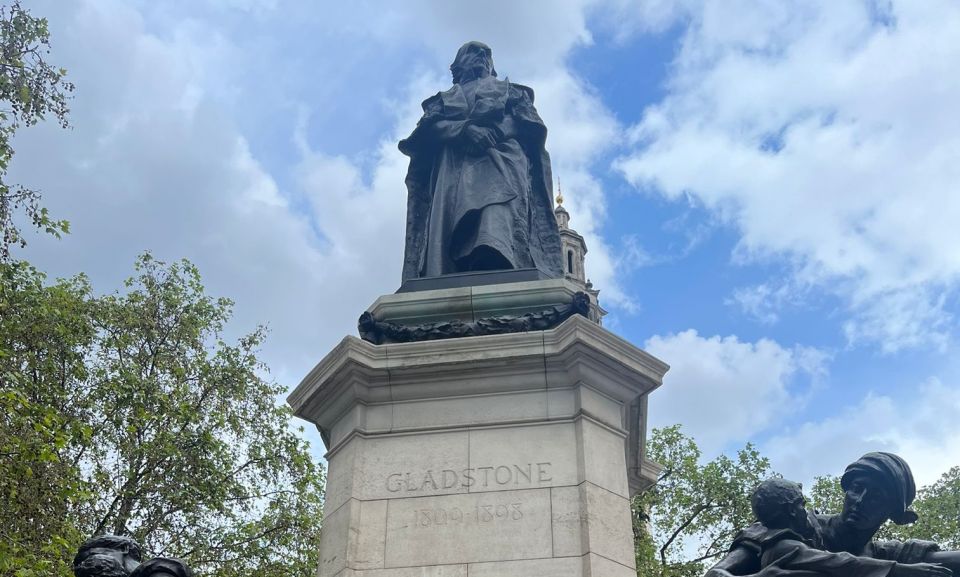
Gladstone’s statue and the politics of truth
The tour uses a statue of Gladstone as a prompt for reflecting on truth and politics. This part is clever because it’s not just “here’s a political figure.” It’s a method prompt: you consider how politics, truth, and history change with perspective.
Then you’ll write a list of facts, blending personal history with the environment you’re a part of. That combination is more interesting than it sounds. Facts can feel neutral, but the moment you connect them to your own life, you learn how perspective edits meaning. In other words: the tour is training you to notice bias—not as a blame game, but as an artistic reality.
This is where the Dickens theme also fits in, even if you’re not standing beside a specific Dickens site on the map. Dickens is famous for attention to social life and the consequences of systems. Paired with Gladstone and the idea of truth changing by viewpoint, the prompt gives you a way to write about politics without turning it into a lecture.
Potential drawback: If you prefer completely personal, non-political writing, this section might feel slightly more demanding. But it’s still handled as writing prompts, not debates. You choose how you respond.
Doctor Johnson’s house: language as identity
At Doctor Johnson’s house, the workshop turns to language structures. You’ll read from his delightful dictionary and consider the way structures—religion, politics, art, and language—make us who we are.
This stop is practical for writers because it turns an abstract idea into a concrete tool. A dictionary is about definition, but Johnson’s presence also suggests how writers build identity through words: what gets labeled, what gets repeated, what gets treated as normal. When you’re asked to reflect on those structures, you’re essentially learning how cultural systems shape the narrator inside your writing.
It also ties back to the whole tour. Woolf starts with perception and memory. Eliot brings time and history. Gladstone prompts perspective and facts. Johnson anchors everything in language. By the end, you’re not just writing about London; you’re writing about how writing itself is shaped by the world.
If you’re someone who wants to improve your writing habits, you’ll likely appreciate this. It points you toward a writing mindset: treat place as text, and treat language as a living set of rules you can rewrite.
Price and value: what $101 buys in 1.5 hours
At $101 per person for a 1.5-hour guided tour and writing workshop, this is priced like a specialized creative class, not a generic sightsee-and-take-photos walk. The good news is that the value comes from the balance: you’re paying for both guidance and active participation.
A few value signals stand out:
- No entry tickets needed, so your money goes directly into the guide-led workshop time.
- Writing exercises are built into every stop, which means you’re not just passing time between landmarks.
- The guide’s creative writing credentials matter because the prompts are designed for all levels, and the readings help you model what to do on the page.
- Private group format often means better attention than a large bus-tour setup, especially if you ask questions or want more feedback on how to approach prompts.
If you’re the type who likes to learn by doing, not by watching, this price starts to look fair. If you only want literary facts and zero participation, you might feel it’s more class-like than expected. But that active component is exactly what makes the tour feel worth it.
Who should book this writing workshop
I think this tour is ideal if you want London through the lens of writers, but you’d rather produce something than just listen. You’ll enjoy it if you like:
- writing practice tied to real places
- prompts that work for beginners and experienced writers
- a gentle, inclusive atmosphere where you can make the exercise your own
- literature that connects to craft and technique, not only biography
It’s also a strong option for solo writers or bookish couples who want an activity with a purpose. And because the tour is wheelchair accessible, you can consider it if mobility access is a concern.
You might hesitate if your goal is purely sightseeing. This experience is not a long cultural lecture, and it doesn’t promise time to linger and fully explore each stop.
Should you book Woolf & Dickens: London Literary Tour & Writing Workshop?
If you’re excited by the idea of turning literary prompts into actual writing, I’d book it. This workshop gives you a clear structure in a short window, with meaningful stops tied to Woolf, Eliot, Dickens, Gladstone, and Doctor Johnson. The strongest reason to go is simple: you leave with sentences you made, not just stories you heard.
But if you want a slow, detailed tour that replaces writing entirely with sightseeing, this may feel too workshop-shaped. For most people who enjoy literature and want a hands-on creative experience, it’s a smart use of time in London.
FAQ
How long is the Woolf & Dickens tour?
The tour lasts about 1.5 hours.
Where do I meet the guide?
Meet at the north end of Waterloo Bridge. Look for the slope on the right that goes behind Somerset House.
Is there an entry ticket cost for the stops?
No. The tour includes the guided experience and writing workshop, and no entry tickets are needed.
What should I bring?
Bring a pen, a notebook, and water. An umbrella is also recommended in case of weather. You’ll also want internet access.
Is the tour suitable for beginners?
Yes. The workshop is designed to suit all levels, from novice to novelist.
Is the tour wheelchair accessible?
Yes, it is wheelchair accessible.